How to Tell How Old a Piece of Furniture Is: An Antique Furniture Dating Guide
Determining the age of a piece of furniture is rarely about finding one definitive clue. More often, it involves looking at a combination of construction methods, materials, hardware, wear and design to build a picture of when and how the piece was made.
At Odloft, we regularly handle antique and vintage furniture from different periods, and some of the most useful clues are often hidden underneath, behind drawers or inside the construction rather than on the decorative surfaces.
Whether you have inherited a chest of drawers, found an old table at an antiques fair or simply want to understand a piece you already own, here are some of the details worth looking for.
Start With the Construction
One of the best ways to estimate the age of furniture is to look at how it was put together.
Modern furniture is usually manufactured using machinery, screws, staples and uniform components. Earlier furniture was often assembled by hand, and variations in the construction can provide useful dating clues.
Look underneath the piece, behind drawers and inside cupboards where later refinishing is less likely to have altered the original surface.
Mortise and Tenon Joints
Mortise and tenon construction has been used for centuries and is particularly common in tables, chairs, benches and cabinets.
A projecting tenon on one piece of timber fits into a corresponding mortise cut into another.
On earlier furniture these joints may be:
- hand-cut
- pegged with wooden dowels
- slightly irregular
- visible from the underside or rear
A pegged mortise and tenon joint does not automatically make a piece exceptionally old, but it can be an important clue when considered alongside other construction details.

Look at the Drawers
Drawers can reveal a great deal about the age of furniture.
Remove one completely and examine its sides, back, bottom and joints.
Dovetail Joints
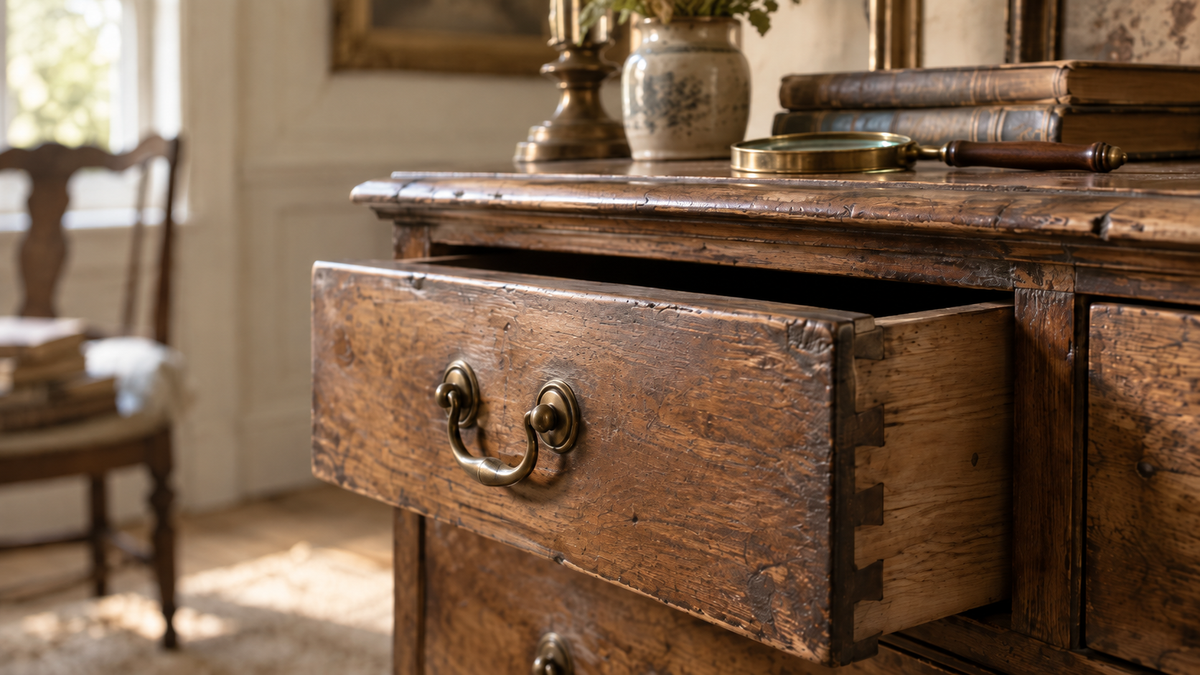
Hand-cut dovetails are usually less regular than machine-cut examples.
Earlier dovetails may:
- vary in width and angle
- show saw marks
- be relatively large
- differ slightly from one drawer to another
By the later 19th century, mechanised production increasingly allowed dovetails to become more consistent.
Perfectly identical dovetails across every drawer are generally more characteristic of machine production, although construction traditions varied between makers and regions.
Nailed Drawers
Not all old furniture uses dovetails.
Primitive, vernacular and country-made furniture may have drawers assembled using nails rather than dovetail joints.
This is why dating furniture from a single feature can be misleading.
A nailed drawer combined with hand-forged nails, old timber, pegged construction and appropriate wear may still indicate considerable age.
Examine the Nails
Nails are one of my favourite clues because they can often reveal whether a piece was made using older construction methods.
Earlier hand-forged nails tend to be irregular.
You may notice:
- uneven heads
- tapered shanks
- inconsistencies between individual nails
- evidence of hand hammering
Later machine-cut nails are generally more regular but often still have a distinctive rectangular shape.
Modern wire nails are round and highly uniform.
However, old furniture is frequently repaired, so finding one modern nail does not necessarily mean the entire piece is modern.
The important question is whether the construction as a whole appears consistent.

Look at Screws Carefully
Screws can also help with dating.
Early handmade screws are often noticeably irregular, with imperfect slots and uneven threads.
As screw manufacturing became mechanised during the 19th century, screws became increasingly consistent.
Modern screws tend to have:
- very regular threads
- perfectly centred heads
- consistent dimensions
Again, replacement screws are common on antique furniture, particularly around hinges, handles and repaired joints.
Never date an entire piece from one screw alone.
Check the Back of the Furniture
The back is frequently more informative than the front.
Earlier cabinets, cupboards and chests may use:
- individual timber boards
- tongue-and-groove construction
- hand-planed boards
- visible saw marks
- handmade nails
Modern furniture is more likely to use plywood, hardboard or manufactured sheet materials.
Wide solid boards can sometimes suggest earlier construction, although timber movement, replacement backs and later repairs all need to be taken into account.
Study the Timber
Knowing what wood you are looking at can help narrow down the likely period and origin.
Common timbers found in British and European antique furniture include:
- oak
- elm
- walnut
- mahogany
- pine
- ash
- beech
- cherry
Different woods became fashionable at different periods and were used differently depending on geography and the quality of the furniture.
For example, mahogany became particularly important in British furniture during the Georgian period, while pine was widely used in vernacular and painted furniture.
Elm is frequently encountered in traditional English chairs and country furniture.
But wood alone rarely provides an exact date.
Look for Hand Tool Marks
Machine-made furniture tends to produce uniform surfaces.
Handmade furniture may show evidence of:
- hand planes
- chisels
- adzes
- pit or frame saws
- hand boring
These marks are often most visible on parts that were never intended to be seen.
Turn a table upside down.
Remove a drawer.
Look at the inside of a cupboard.
The hidden surfaces are often where the history survives.
Hardware Can Be Extremely Useful
Handles, locks, hinges and escutcheons can all help with dating.
Look at whether the hardware appears original.
Signs may include:
- matching wear around handles
- old fixing holes
- oxidisation
- handmade screws
- outlines showing where earlier fittings once sat
Furniture often acquires replacement handles during its lifetime.
You might find, for example, Victorian furniture fitted with later reproduction brass handles while the original lock, timber and drawer construction remain untouched.
In those situations, the furniture should be dated from the underlying construction, not the replacement fittings.
Look for Evidence of Previous Handles
Old furniture frequently carries a record of its alterations.
Inside the drawer front you may find plugged holes from an earlier set of handles.
These can tell you that the visible handles are replacements.
This doesn't necessarily reduce the importance or age of the furniture, but it should be mentioned in an accurate condition report.
At Odloft, we think these changes are part of the history of a piece rather than something that always needs to be hidden.
Wear Should Make Sense
Genuine age should normally produce wear in logical places.
On a chair you may see wear:
- on the front stretcher
- around the arms
- at the seat edge
- where hands naturally grip
On a chest of drawers:
- around handles
- along drawer runners
- on projecting corners
- around the feet
On a table:
- around the edge of the top
- beneath the legs
- where chairs have repeatedly contacted the frame
Artificially distressed furniture can imitate colour and surface wear, but genuine ageing usually appears inconsistently and in areas that correspond with decades of normal use.
Patina Is More Than Colour
Patina is sometimes misunderstood as simply meaning dark wood.
True patina develops through a combination of:
- oxidation
- handling
- sunlight
- wax
- dirt
- cleaning
- surface wear
- environmental exposure
It often produces subtle differences in colour and texture across the furniture.
A surface protected inside a drawer, beneath a handle or against a wall may look quite different from an exposed surface.
Those contrasts can help tell the story of the piece.

Can Furniture Be Old Even If Parts Have Been Replaced?
Absolutely.
Antique furniture has often been repaired and altered during its lifetime.
You may encounter:
- replacement handles
- later hinges
- replaced drawer runners
- repaired legs
- new upholstery
- replacement mirror glass
- added strengthening
- later paint
These alterations need to be assessed individually.
Replacing a damaged piece of leather on a 19th-century chair, for instance, does not suddenly turn the chair into a modern reproduction.
What matters is identifying which elements are original and which are later.
Style Can Help — But Don't Rely on It Alone
Furniture styles are constantly revived.
A chair that looks Georgian may actually be Victorian.
A Jacobean-style table may have been made in the late 19th or early 20th century.
An Art Deco-inspired cabinet could have been produced decades later.
This is why construction should generally carry more weight than appearance alone.
Use style as one clue among many.
Antique, Vintage or Reproduction?
As a general rule, an antique is normally understood to be at least 100 years old.
Vintage usually describes later pieces that have some age and design significance but have not yet reached antique status.
And a reproduction is a later piece deliberately made in the style of an earlier period.
The boundaries are not always neat, which is why examining the construction remains so important.
A Simple Antique Furniture Dating Checklist
When examining a piece, look at:
- Joints — hand cut or machine made?
- Drawers — dovetailed, nailed or screwed?
- Nails — forged, cut or modern wire?
- Screws — irregular early screws or modern uniform ones?
- Backboards — solid timber or manufactured board?
- Tool marks — signs of hand construction?
- Timber — appropriate to the supposed period?
- Hardware — original or replacement?
- Wear — does it correspond with genuine use?
- Style — is the construction consistent with the design period?
The most reliable assessment comes from considering all of these clues together.
Every Piece Tells a Story
One of the reasons we enjoy antique furniture is that no two pieces age in exactly the same way.
Tool marks, repairs, worn handles and old nail holes are not simply imperfections. They are evidence of how furniture has been made, used, adapted and cared for across generations.
At Odloft, we try to preserve those details wherever possible and describe the construction and condition of our furniture accurately, allowing its history to remain part of its character.
Browse our current collection of antique and vintage furniture at Odloft.